
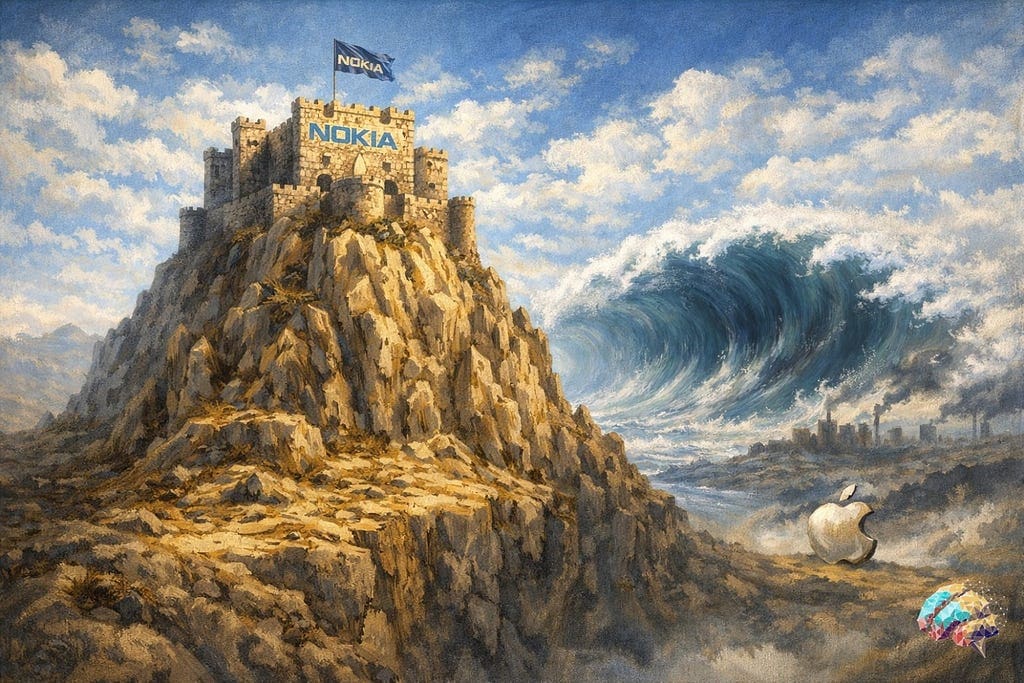
“A peak always conceals a treacherous valley.” — Shigetaka Komori, former CEO of Fujifilm
Financial markets, like organisations, follow rhythms. History rarely repeats itself cleanly, but it often rhymes. One of those quieter rhymes appears every December and is known as the Santa Claus Rally.
First described by Yale Hirsch in The Stock Trader’s Almanac in 1972, it refers to the final five trading days of the year, and the first two of the next. The rally is not driven by news or earnings calls. It is a habit. Professionals step back in after booking losses and adjusting portfolios. When the rally appears, it feels reassuring. But when it is absent, it signals danger. Hirsch’s father had a line for this: “If Santa Claus should fail to call, bears may come to Broad and Wall.”
A failed rally is not about missing a marginal gain, but functions as a tripwire. It is a signal that the system is no longer behaving as it normally does.
Organizations experience a dangerous version of this phenomenon. There are periods when margins expand, leadership narratives settle, and forecasts stabilize. These moments are often interpreted as health. In practice, they are frequently when vulnerability begins to accumulate. Profitability can become a leading indicator of decline when it is driven by retreat rather than reinvention.
Seneca captured this asymmetry long before modern economics gave it a name. “Fortune”, he observed, “tends to grow slowly, while ruin arrives quickly”.
Growth usually emerges through incremental effort over time. Decline, when it arrives, accelerates. What takes years to build can unravel with surprising speed. The danger rarely lies in sudden crisis. It lies in gradual erosion, composed of reasonable decisions made sequentially, each defensible in isolation. Before we visit the historical example that anchors this essay, we must look at two recent precursors.
Profit as Camouflage
Nokia Fort
“The arrogance of success is to think that what you did yesterday will be sufficient for tomorrow.” — William Pollard
It is easy to dismiss the stories of Nokia and BlackBerry as worn-out case studies. However, remain essential because they prove the specific mechanics of the Santa Rally trap. We tend to remember their crash; we forget the “festive profits” that blinded them to it. (in 2026, we will be launching a deep dive into these very stories, featuring insights from Nokia scholars quy huy, Timo Vuori. Later we will host Jacquie McNish , author of Losing the Signal.)
In November 2007, just months after the iPhone launched, Forbes ran a cover story with the headline: “Nokia, One Billion Customers — Can Anyone Catch the Cell Phone King?”. Inside Nokia, the company still held a dominant position, controlling roughly half of the global smartphone market. They possessed “bountiful economic and intellectual resources”. By conventional financial measures, the business was performing exceptionally well.
The Cell Phone King
That surge in profitability was not renewal. Top managers developed an “overly optimistic perception” of their capabilities. Strong profits reassured leadership, leading to “temporal myopia”, a focus on short-term product innovation at the expense of long-term development.
The rally did not reveal the rot, just camouflaged it.
A similar dynamic played out at BlackBerry. When the iPhone launched, co-CEO Jim Balsillie dismissed it. He called it “kind of one more entrant into an already very busy space” and said it was overstating things to call it a sea change. In 2008, BlackBerry enjoyed nearly half the mobile phone market. Revenues had doubled to $6 billion. Over the next three years, they tripled to a peak of nearly $20 billion! It is no wonder Balsallie and team just focused on what they were doing, they were enjoying a multi-year Santa Rally.
Blackberry Stock
However, they were soon to experience what I call a “Long Kiss Goodnight” curve. It is a gradual climb to the top of the mountain followed by what seems like a dramatic fall, followed by a prolonged near death experience for years. When asked about diversifying, Balsillie famously said they would “preferably die.” He admitted they were a poorly diversified portfolio that would either “go to the moon” or “crash to the earth” and crash it did.
The incredible growth did not reveal the slow erosion, it only amplified confidence. Profitability allowed the company to extract value from a model whose relevance was eroding. To see this pattern in its clearest form, we now turn to an industry shaped long before cell phones existed.
The Ghosts of Christmas Past
A little town named Bethlehem
“As organisations enjoy cutting seemingly wasteful costs on R&D or Innovation, startups might step in and offer to take the low-margin product. The disrupter is motivated to add the very products the incumbent is motivated to ignore because the margin appears too low. Of course, if the startup has enough runway, they keep improving and adding more offerings. Eventually, the tables turn and the disruption comes from below.” — Clayton Christensen and Scott D. Anthony
There is a poetic irony in the timing of my article. I have just returned from a live series tour in Boston, where I recorded with Scott Anthony on his new book, Epic Disruptions, in which he features Bethlehem Steel. The company was headquartered in Bethlehem, Pennsylvania. The town was founded on Christmas Eve in 1741 and known to this day as “Christmas City, USA.”
But while the biblical Bethlehem is a story about a birth and a new beginning, the corporate Bethlehem is a story about an end. And the two stories share a lesson. The future is often born in the “manger” as a symbol for the low-end, overlooked place that the Kings of the industry are too proud to occupy.
The Kings, in this case, were the “Integrated Mills.” These were massive operations. Building just one of these mills cost the equivalent of $4 billion today. These titans were powerful, massive, and seemingly immovable.
Then, in the late 1960s, a “flea” arrived. It was called Nuclear Corporation (later Nucor), and they pioneered the “minimill.”
Minimills were different. Instead of massive blast furnaces, they used electric arc furnaces to melt down scrap metal. They were cheaper to build and run, but they had a major limitation. The steel they produced was low quality. It was gritty, uneven, and useless for high-end applications.
The only thing minimills could produce reliably was rebar. Rebar was the rugged steel bars we see buried inside concrete.
In the steel industry, rebar was the bottom of the barrel. It was the “manger” of the market. The margins were terrible (around 7%), and the customers were price-sensitive and disloyal.
When Nucor and the minimills attacked the rebar market with rock-bottom prices, the giant Integrated Mills looked at their spreadsheets. They saw a market segment that was a headache to serve and barely profitable. Margins were thin; customers were disloyal. So, the executives at the big mills made a rational financial decision. They said: “Let them have it.”
For the executives, the immediate effect was positive. By shedding their least profitable product, their average margins rose. It looks like a brilliant strategic move.
This is the Innovator’s Dilemma. By shedding their least profitable product, the incumbent’s average margins rose immediately. They experienced their own corporate Santa Rally. It looked like a brilliant strategic move. But by ceding the low end, they gave a competitor a foothold.
Once the high-cost giants left the manger, the minimills were left fighting one another in the straw. Prices collapsed. Margins wore wafer-thin. To survive, the disruptors had to move. They looked upstream at the higher-margin customers the incumbents were serving.
Because the incumbent had ceded the low ground, the disruptor had the runway to build capability. They had no choice but to “find a way” to compete.
When Nucor figured it out, they moved into the next tier: angle iron and rods. Again, the integrated mills looked at the margins, compared them to their high-end sheet steel, and handed over the lower-end market.
This retreat signals a dangerous Shifting Baseline. Initially, the baseline for the integrated mills was: “We dominate the entire steel market.” But when they ceded rebar, they unconsciously reset their baseline. The new normal became: “We dominate the quality steel market.” When they ceded angle iron and rods, the baseline shifted again: “We dominate the premium steel market.”
By constantly redefining “the market” to exclude the segments they were losing, the executives maintained the illusion of victory. They weren’t retreating; they were “focusing on value.”
This shifting baseline allowed them to feel successful even as their world shrank. With every retreat, the incumbent’s profitability improved. With every retreat, they felt the warmth of a “Santa Rally.” They celebrated record margins right up until the snow melted and as Andy Grove once said, “Snow Always Melts at the Edges.”
He meant that the first signs of permanent change don’t happen in the mainstream center, but at the periphery — the very “edges” incumbents are so happy to cede.
This is the danger of the corporate Santa Rally. It creates a feeling of abundance precisely when a cycle is ending.
The January Reality
Crash back to earth on thin ice
As the year closes and results are reviewed, rising profits warrant scrutiny. Sometimes they reflect genuine growth. But sometimes, they reflect withdrawal, cutting R&D, jettisoning difficult customers, firing your intrapreneurs or abandoning low-end markets.
Not to be a grinch, but sometimes when the numbers look best, it is because the future has already been outsourced to someone else.
A very happy holiday to those who celebrate Christmas. It can be a time of mixed emotions. My support to you if you are struggling in any way.
As you know, we have never missed a week of this show or Thursday Thought in almost a decade and we ain’t gonna start now. Over Christmas, we have the 4th and final episode in what was meant to be one episode with Chuck House. We have Teresa Amabile and my great friend Paul Nunes live at Harvard Business School.
Thank you for your support of the show, it has been an incredible year for us.
I hope to up our game and bring you even more quality next year, actually starting right now with this episode of The Innovation Show on tour.
This 3-part series is in Harvard Business School and begins with friend and Innovation Show regular, Scott D. Anthony.
Enjoy and happy holidays. Aidan.
https://medium.com/media/1038890220009287a4ef9060bae5d8ed/href
The Santa Rally and the Ghosts of Bethlehem: Why Record Profits Can Signal Demise was originally published in The Thursday Thought on Medium, where people are continuing the conversation by highlighting and responding to this story.
The post The Santa Rally and the Ghosts of Bethlehem: Why Record Profits Can Signal Demise appeared first on The Innovation Show.